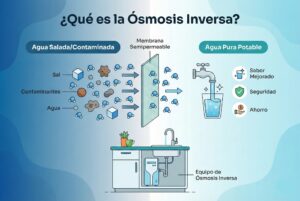
More and more people are wondering whether osmosis water is good. Generally speaking, the answer is yes: reverse osmosis is one of the most effective technologies for improving certain characteristics of drinking water in the home. But the final result does not depend solely on buying a machine. It depends on choosing the right equipment for the water in the property, installing it correctly, checking that it works properly and maintaining it according to sound technical criteria.
And this is one of the differences that is most often overlooked: an osmosis system should not be purchased as if it were a standard household appliance. Two homes may require different solutions, even though at first glance they appear to be looking for exactly the same thing: “installing an osmosis system under the sink”.
In recent years, these systems have become increasingly common in large DIY and supply stores, online platforms and also as an add-on during kitchen or home renovations. This has made the technology more accessible, but it has also meant that, in many cases, the decision comes down to comparing price, number of stages or appearance, while overlooking what really matters: what kind of water we have, what equipment we need and who will provide support after installation.
How direct-flow osmosis works and why it is not a standard product
Understanding how direct-flow osmosis works helps explain why not all systems or installations deliver the same results. Unlike traditional systems with a storage tank, direct-flow systems produce osmosis-treated water when the tap is opened, usually using higher-capacity membranes and, in many models, with the help of a pump.
This technology can offer some very interesting advantages:
- Greater water availability without relying on a storage tank.
- More compact systems and better use of the space under the sink.
- Water produced at the moment it is needed.
- Good flow rate when the system is correctly sized and the operating pressure is adequate.
- The possibility of incorporating electronic controls, maintenance alerts and leak protection systems.
But “direct flow” does not mean “equally suitable for every home”. Inlet pressure, water hardness, conductivity, water temperature, expected consumption, membrane quality, whether or not a water softener is installed upstream and the available space can all affect performance, wastewater ratio and the lifespan of consumables.
The reality of systems sold in DIY stores or supply centres
Large DIY stores, industrial hardware stores and supply centres sell reverse osmosis systems, just as they sell hundreds or thousands of plumbing, renovation, construction and household products. The problem is not that a system is automatically bad because it is sold there. The problem is confusing the sale of a product with a professional water treatment assessment.
At a large retail store, customers may find a system at an attractive price and take it home immediately. However, before choosing a reverse osmosis system, it is worth answering questions that are rarely resolved simply by reading the product packaging:
- What are the hardness and conductivity levels of the water in the property?
- Is the available pressure sufficient and stable?
- Is there already a water softener installed, or would one be advisable?
- What rejection rate can be expected under these conditions?
- What replacement parts does the system use, and will they still be easy to find in a few years?
- Who will check that the system is working correctly after installation?
- Who will provide support if the system develops a fault?
Buying a reverse osmosis system is easy. Choosing the right water treatment solution requires more than that.
That is why it is important to distinguish between a general retailer and a specialist company. A large store can sell the equipment; a specialist should assess the water, recommend the appropriate system, install it, commission it, verify its performance and support the customer throughout the equipment’s service life.
Home and kitchen renovations: installing reverse osmosis is not the same as being a water treatment specialist
Another increasingly common situation arises during a renovation. The kitchen is replaced, the plumbing is renewed and, while the work is being carried out, a reverse osmosis system is offered as just another part of the project, as if it were another household appliance.
A renovation contractor or kitchen installer may be perfectly capable of carrying out plumbing work. But knowing how to connect a machine does not necessarily mean knowing how to size, adjust and diagnose a water treatment system. They are related areas of expertise, but they are not the same.
When reverse osmosis is added as another accessory during a renovation, there is a risk that the choice will be based on availability, price or ease of installation, without assessing factors such as water hardness, pressure, actual membrane performance, treated water quality or future maintenance requirements.
Furthermore, months or years later, when the system needs servicing, develops a fault or experiences a reduction in flow, it is common for the company that carried out the renovation no longer to provide this type of service. In water treatment, after-sales support and maintenance are part of the solution from day one.
DIY maintenance and maintenance without proper checks
One of the most common messages when selling domestic systems is that maintenance simply consists of changing the filters from time to time. Replacing consumables is important, but this alone does not guarantee that the system is working correctly.
During a professional service, depending on the type of system, the following aspects can be checked:
- Condition and replacement date of the pre-filters.
- Membrane performance and salt rejection rate.
- Conductivity or dissolved solids in the inlet water and treated water.
- Operating pressures and pump performance.
- Actual production flow rate.
- Condition of connections, tubing, tap and drain.
- Operation of leak sensors, solenoid valves and pressure switches.
- Need to sanitise the circuit according to the system and the manufacturer’s instructions.
- Water quality control tests.
A user can replace a filter and leave the machine running, but without a technical check they will not always know whether the system as a whole is still delivering the expected performance. This is one of the reasons why professional maintenance should not be reduced simply to “changing cartridges”.
Benefits of osmosis water when the system is properly managed
When the system is suitable for the incoming water and is properly maintained, reverse osmosis can provide a very noticeable improvement in the drinking experience:
- Reduction of dissolved salts and many substances that the membrane is able to retain.
- Improved taste and odour when compounds affecting them are present.
- Water that is highly suitable for drinking, cooking, making coffee, tea or ice.
- Less reliance on bottled water.
- More consistent quality when the system is properly monitored and maintained.
However, these benefits must always be considered in relation to the actual performance of each system and the conditions of the incoming water. The fact that the machine “produces water” is not enough to assume that it is working as well as it did on the first day.
Systems with remineralisation: a key detail that makes a difference
After the membrane, some systems include a remineralisation stage. Its purpose is to modify certain characteristics of the treated water, mainly to achieve a mineral profile and taste that are more pleasant according to the manufacturer’s design.
Not every user needs exactly the same configuration, and not all remineralisation systems work in the same way. What matters is understanding what the system actually includes rather than buying solely on the basis of a marketing label.
A specialist can explain whether the model includes remineralisation, where in the circuit it takes place, what maintenance it requires and what effect it has on the final water. This advice is particularly useful when comparing systems that appear similar but have very different prices.
Home safety: leak sensors and genuine peace of mind
A reverse osmosis system remains permanently connected to the water supply. For this reason, in addition to filtration quality, it is important to consider the hydraulic safety of the installation as a whole.
Many modern systems include leak sensors, shut-off solenoid valves and electronic systems capable of stopping the water supply when they detect an abnormality. Not all models offer the same level of protection, and this is something worth comparing before purchasing.
The quality of the connections, installation of the tubing, correct connection to the drain and the final leak-tightness test are also important. In a professional installation, safety should not be treated as an optional extra: it is part of the job.
Direct-flow osmosis: price or real value
When comparing direct-flow reverse osmosis systems, it is very easy to focus solely on the purchase price. However, two machines that apparently do the same thing can differ in component quality, actual production capacity, efficiency, electronics, availability of spare parts, leak protection, maintenance costs and after-sales service.
An inexpensive system is not necessarily a bad purchase, just as an expensive system is not automatically better. A proper comparison should take the whole package into account: product, suitability for the water, installation, commissioning, maintenance, spare parts and technical support.
That is why, when a quotation from a specialist company is compared with the price of a boxed system in a large retail store, the two are not always equivalent. In one case you are buying a product; in the other, you should be purchasing a complete solution.
What should a specialist do before and after installing a reverse osmosis system?
A professional water treatment service should go beyond simply placing the equipment under the sink. At a minimum, it should include:
- Understanding the basic characteristics of the incoming water.
- Checking the pressure conditions and the available installation.
- Selecting a system suited to the household’s consumption and requirements.
- Explaining to the customer what the system does and what its limitations are.
- Carrying out a neat, accessible and safe installation.
- Commissioning the system and checking that it produces water correctly.
- Explaining the maintenance requirements and costs.
- Providing access to spare parts and technical support.
- Checking system performance during maintenance visits rather than simply replacing filters.
The difference lies in how it is done
Reverse osmosis, and especially modern direct-flow systems, can be an excellent solution for improving drinking water at home. But the result does not depend solely on buying a machine with many stages, a digital display or an attractive price.
The real difference lies in the complete package: the right equipment + water assessment + professional installation + commissioning + maintenance + technical support.
That is why, before buying a reverse osmosis system from a large retail store, online or as an add-on to a kitchen renovation, it is worth asking a simple question: am I simply buying a machine, or am I entrusting the water I will drink every day to a professional who will also be able to advise me after the sale?
Making an informed choice is the first step towards enjoying high-quality water and a system that continues to work properly for years.
Are you thinking about installing or replacing a reverse osmosis system?
Before making a decision based solely on price, consult a water treatment specialist. A proper assessment from the outset can help prevent performance problems, inadequate maintenance and systems that do not meet the real needs of the household.
The goal is not to sell a machine. It is to ensure that the chosen system works properly today and continues to do so over time.